
Associate of Applied Science in Respiratory Therapy
Prepare for a Career in Respiratory Therapy
Learn to evaluate, treat, and care for patients with breathing and cardiopulmonary conditions through classroom, lab, and clinical training in St. Louis.
- Credential
- Associate of Applied Science
- Total Credits
- 81
- Program Length
- 90 weeks6 semesters
- Clinical Training
- 765 hoursclinical practicum
- Tuition
- $475/credit~$38,475 before fees
Request submitted
Thanks for your interest in Stepful College. We've received your information and a member of our admissions team will be in touch soon.
Questions? Call (636) 529-0000
'/%3e%3cpath%20d='M1191.87%20927.714C872.55%201171.7%20383.135%201109.25%20238.291%20856.15C93.4481%20603.052%20-71.4534%20698.718%20203.243%20521.193C477.94%20343.667%20638.306%20659.422%20953.414%20533.329C1268.52%20407.236%201511.19%20683.726%201191.87%20927.714Z'%20fill='url(%23paint1_radial_8008_7536)'/%3e%3cpath%20d='M1191.87%20927.714C872.55%201171.7%20383.135%201109.25%20238.291%20856.15C93.4481%20603.052%20-71.4534%20698.718%20203.243%20521.193C477.94%20343.667%20638.306%20659.422%20953.414%20533.329C1268.52%20407.236%201511.19%20683.726%201191.87%20927.714Z'%20fill='url(%23paint2_radial_8008_7536)'/%3e%3c/g%3e%3cdefs%3e%3cradialGradient%20id='paint0_radial_8008_7536'%20cx='0'%20cy='0'%20r='1'%20gradientTransform='matrix(-108.554%20328.525%20301.298%20-70.4232%20989.715%2060.0751)'%20gradientUnits='userSpaceOnUse'%3e%3cstop%20stop-color='%2391D4BF'/%3e%3cstop%20offset='1'%20stop-color='%2391D4BF'%20stop-opacity='0'/%3e%3c/radialGradient%3e%3cradialGradient%20id='paint1_radial_8008_7536'%20cx='0'%20cy='0'%20r='1'%20gradientTransform='matrix(219.346%20-246.304%20-516.762%20-99.117%20661.815%20634.904)'%20gradientUnits='userSpaceOnUse'%3e%3cstop%20stop-color='%2391D4BF'/%3e%3cstop%20offset='0.75'%20stop-color='%2391D4BF'%20stop-opacity='0'/%3e%3c/radialGradient%3e%3cradialGradient%20id='paint2_radial_8008_7536'%20cx='0'%20cy='0'%20r='1'%20gradientTransform='matrix(125.215%20-97.5108%20-155.293%20-111.931%20299.354%20903.582)'%20gradientUnits='userSpaceOnUse'%3e%3cstop%20stop-color='%2391D4BF'/%3e%3cstop%20offset='1'%20stop-color='%2391D4BF'%20stop-opacity='0'/%3e%3c/radialGradient%3e%3c/defs%3e%3c/svg%3e)
Why Respiratory Therapy
Help patients breathe when it matters most
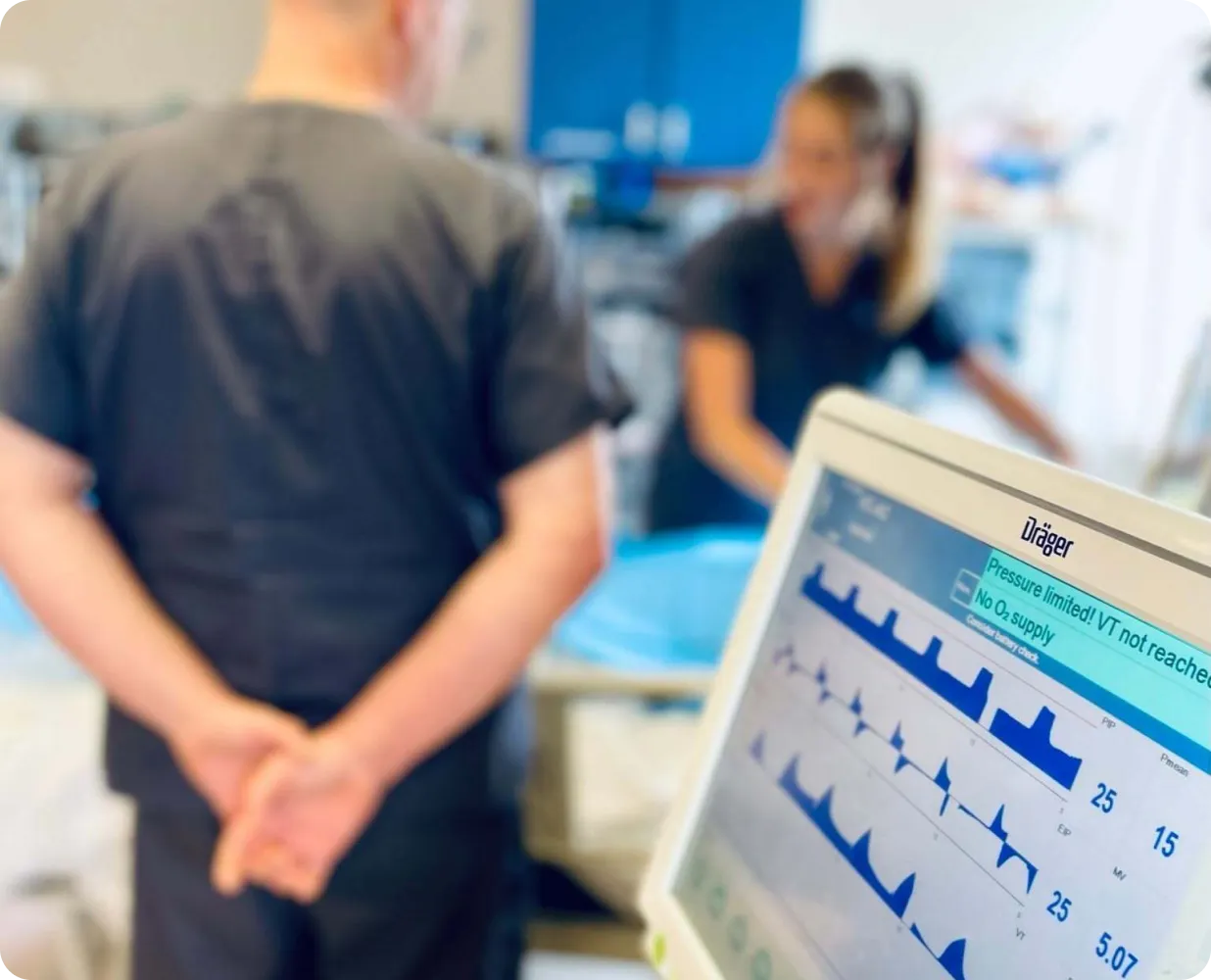
Respiratory therapists care for people whose breathing has been affected by illness, injury, premature birth, chronic disease, or a medical emergency. They assess patients, perform diagnostic testing, administer treatments, manage respiratory equipment, and support patients who require mechanical ventilation.
Respiratory therapists work with patients of all ages, from premature infants in neonatal intensive care to adults managing asthma, emphysema, and other cardiopulmonary conditions.
What You'll Learn
Develop the skills to provide advanced respiratory care
Build the scientific knowledge, technical skills, and clinical judgment needed to evaluate patients and provide evidence-based respiratory care across diverse patient populations.
- Assess patients and evaluate their need for respiratory care
- Administer oxygen, aerosol medications, and therapeutic treatments
- Initiate and manage mechanical ventilation and life-support equipment
- Conduct arterial blood gas and pulmonary function testing
- Care for adult, pediatric, and neonatal patients
- Communicate with patients, families, physicians, and care teams

Curriculum
Six semesters of respiratory care education
Progress from foundational science and general education into respiratory procedures, mechanical ventilation, advanced patient care, and extensive clinical experience.
Semester 1
Healthcare and Science Foundations
Build foundational knowledge through anatomy and physiology, medical terminology, psychology, mathematics, and pathophysiology — the groundwork for respiratory care.
Semester 2
Cardiopulmonary Foundations
Study cardiopulmonary anatomy and physiology, integrated health sciences, English composition, and essential medical terminology.
Semester 3
Respiratory Care Fundamentals
Begin respiratory pharmacology, patient-care procedures, laboratory practice, professional communication, and clinical readiness.
Semester 4
Mechanical Ventilation and Diagnostics
Study respiratory pathology, mechanical ventilation, arterial blood gas analysis, pulmonary function testing, and advanced therapeutics.
Semester 5
Specialized Respiratory Care
Develop skills in neonatal and pediatric care, alternative respiratory settings, critical thinking, quality improvement, and credentialing readiness.
Semester 6
Advanced Practice and Credential Preparation
Complete advanced mechanical ventilation, comprehensive credentialing review, laboratory skill refinement, and national certification readiness.
81 credits1,920 instructional hours765 clinical hours270 laboratory hours

After Graduation
Pursue the Registered Respiratory Therapist credential
Stepful College graduates are eligible to apply to sit for the board examination series administered by the National Board for Respiratory Care (NBRC) to earn the Registered Respiratory Therapist (RRT) credential.
After completing the program, graduates earn an Associate of Applied Science and are eligible to apply for the credentialing examination pathway administered by the National Board for Respiratory Care.
Successful completion of the applicable NBRC credentialing requirements can lead to the Registered Respiratory Therapist credential. State licensure requirements are separate and vary by state.
Credential Pathway at a Glance
- 81
- Degree Credits
- AAS
- Degree Earned
- NBRC
- Credentialing Body
- RRT
- Credential Goal

Career Settings
Work wherever patients need respiratory care
Respiratory therapists provide care across hospital, diagnostic, and home-based settings where patients need cardiopulmonary testing, treatment, or breathing support.
- Hospitals and intensive care unitsNeonatal and pediatric care units
- Pulmonary function laboratoriesHome respiratory-care services
Accreditation
Accredited for respiratory therapy education
Stepful College is institutionally accredited by the Accrediting Bureau of Health Education Schools. The Associate of Applied Science in Respiratory Therapy program at the County Campus holds Continuing Accreditation from the Commission on Accreditation for Respiratory Care.
CoARC Program Number: 200553 • Campus: County Campus, Fenton, Missouri

'/%3e%3cpath%20d='M1167.92%20865.592C862.34%201126.44%20370.37%201090.57%20212.079%20845.729C53.7893%20600.891%20-105.66%20705.316%20158.972%20513.231C423.604%20321.145%20600.78%20627.694%20908.539%20484.769C1216.3%20341.843%201473.51%20604.743%201167.92%20865.592Z'%20fill='url(%23paint1_radial_7756_4123)'/%3e%3cpath%20d='M1167.92%20865.592C862.34%201126.44%20370.37%201090.57%20212.079%20845.729C53.7893%20600.891%20-105.66%20705.316%20158.972%20513.231C423.604%20321.145%20600.78%20627.694%20908.539%20484.769C1216.3%20341.843%201473.51%20604.743%201167.92%20865.592Z'%20fill='url(%23paint2_radial_7756_4123)'/%3e%3c/g%3e%3cdefs%3e%3cradialGradient%20id='paint0_radial_7756_4123'%20cx='0'%20cy='0'%20r='1'%20gradientTransform='matrix(-90.6011%20333.844%20296.982%20-86.6023%20919.179%2010.3472)'%20gradientUnits='userSpaceOnUse'%3e%3cstop%20stop-color='%2391D4BF'/%3e%3cstop%20offset='1'%20stop-color='%2391D4BF'%20stop-opacity='0'/%3e%3c/radialGradient%3e%3cradialGradient%20id='paint1_radial_7756_4123'%20cx='0'%20cy='0'%20r='1'%20gradientTransform='matrix(205.654%20-257.754%20-521.255%20-70.9982%20622.924%20601.946)'%20gradientUnits='userSpaceOnUse'%3e%3cstop%20stop-color='%2391D4BF'/%3e%3cstop%20offset='0.75'%20stop-color='%2391D4BF'%20stop-opacity='0'/%3e%3c/radialGradient%3e%3cradialGradient%20id='paint2_radial_7756_4123'%20cx='0'%20cy='0'%20r='1'%20gradientTransform='matrix(119.73%20-104.12%20-161.086%20-103.343%20275.605%20889.778)'%20gradientUnits='userSpaceOnUse'%3e%3cstop%20stop-color='%2391D4BF'/%3e%3cstop%20offset='1'%20stop-color='%2391D4BF'%20stop-opacity='0'/%3e%3c/radialGradient%3e%3c/defs%3e%3c/svg%3e)
Admissions
What you need to apply
Contact admissions to confirm current enrollment availability, application deadlines, entrance requirements, and documentation requirements for the Respiratory Therapy program.
High school diploma or recognized equivalent
Completed application and educational records
Respiratory Therapy HESI entrance exam
Admissions review
Background screening before clinical training
Before clinical training
Complete health and clinical requirements
Before entering clinical training, students must satisfy the applicable health, safety, certification, and clinical-site requirements. These may include a physical examination, immunization and tuberculosis documentation, drug screening, background or fingerprint screening, and required CPR-related certifications. Requirements may vary by clinical site and are subject to change.
Tuition & Financial Aid
Understand the full cost of the program
Tuition is charged per credit. Additional expenses include textbooks, technology, laboratory instruction, uniforms, certifications, screening, and credentialing or licensure costs.
- $475
- Per credit
- 81
- Total credits
- $38,475
- Tuition before fees or financial aid
Additional cost & aid information
Program costs
Estimated program costs are approximately $5,125 and cover laboratory instruction, technology, uniforms, and related program expenses.
Textbooks
Estimated textbook costs are approximately $1,645 across the program.
Additional fees
Current listed fees include a $75 HESI entrance exam, a $45 background check, a $75 enrollment fee, and a $100 graduation fee, plus approximately $470 in certification and licensure costs.
Financial aid and payment options
Federal financial aid, scholarships, workforce funding, and payment options may be available to eligible students.
Start your path toward respiratory therapy
Request information to learn more about admissions, upcoming start dates, tuition, clinical training, and the Respiratory Therapy Associate of Applied Science program.
Questions? Call (636) 529-0000